

Article
Understanding the climatic pain points is necessary for policymakers hoping to minimize the war’s negative environmental consequences.
Alejandro Martin Rodriguez, Joy Arkeh, Sarah Yerkes
{
  "authors": [
    "Alia Sajjadian",
    "Andrew Leber"
  ],
  "type": "commentary",
  "centerAffiliationAll": "dc",
  "centers": [
    "Carnegie Endowment for International Peace"
  ],
  "englishNewsletterAll": "menaTransitions",
  "nonEnglishNewsletterAll": "",
  "programAffiliation": "MEP",
  "programs": [
    "Middle East"
  ],
  "regions": [
    "Iran",
    "Middle East"
  ],
  "topics": [
    "Energy",
    "Military"
  ]
}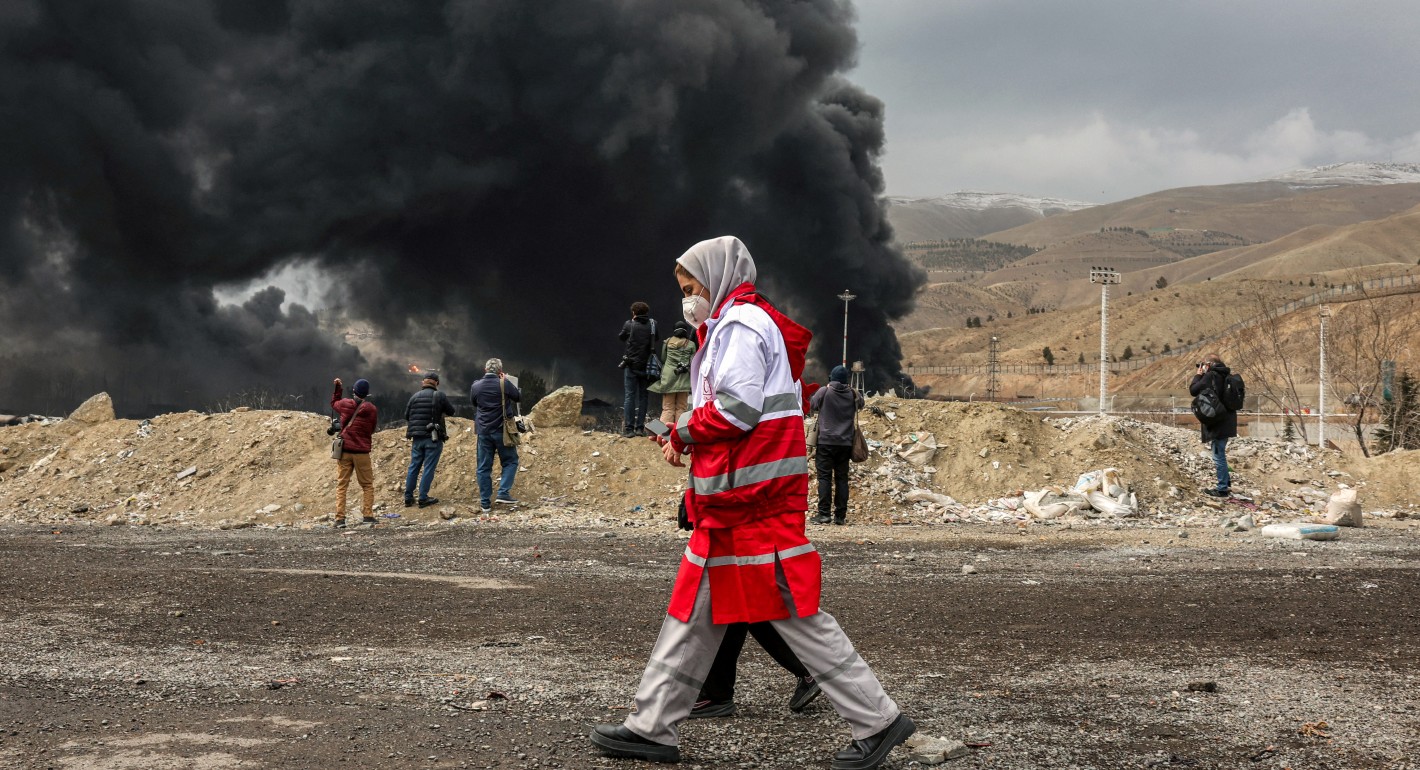
Iranian Red Crescent society workers walk near smoke from airstrikes on the Shahran oil refinery near Tehran on March 8, 2026. (Photo by AFP via Getty Images)
Acknowledging these harms strengthens the case for ethical limits on the weaponization of critical infrastructure.
Damage to energy infrastructure has been a hallmark of the Iran war, with the latest escalation once again targeting energy supply chains—and even water sources—across the Persian Gulf. These tactics reflect a shared view by U.S. and Iranian officials that oil refineries, pipelines, and potentially even power plants are fair game in seeking to coerce the other side (for Iran, via pressure on the Arab Gulf monarchies) into making concessions.
Energy targeting is not unique to this conflict—notably, Ukraine has targeted Russian oil refineries during the ongoing Ukraine war. However, the conflict with Iran is uniquely dangerous in terms of the scale of potential harm to the environment and civilian populations.
In the Persian Gulf, where oil and gas infrastructure is inextricably linked to regional stability and an irreplaceable base of Gulf economies, energy attacks impose disproportionate and lasting burdens on vulnerable civilians. Even if precise strikes appear to have limited direct civilian casualties, the resulting spills, fire, or environmental contamination move through shared waters and air. Worse, the continuation of energy infrastructure attacks risks normalizing attacks on desalination plants, with potentially catastrophic consequences.
Acknowledging these harms strengthens the case for ethical limits on the weaponization of critical infrastructure, and may form a starting point for regional trust and cooperation amid the fraught reality in the Persian Gulf at present.
Energy infrastructure sits at a crossroads in international laws governing warfare. Additional protocols to the Geneva Conventions prohibit attacks on civilian infrastructure unless directly and clearly used to support an adversary’s military. Fuel and power infrastructure falls into the ambiguous space between those two rules. Energy infrastructure can be dual-use, potentially powering both military and civilian systems, leaving it to be exploited to inflict economic pain—to dangerous effect.
Targeting energy infrastructure has long been an instrument of warfare in the Middle East. Notably, retreating Iraqi forces in the 1991 Gulf War set fire to more than 700 Kuwaiti oil wells. The blaze continued for nearly ten months, releasing millions of barrels of oil into the air and creating oil lakes across the surrounding terrain. Roughly 11 million more barrels were spilled into the Persian Gulf, fouling hundreds of kilometers of coastline. In the 2006 Lebanon war, attacks triggered the Jiyeh plant oil spill, when tens of thousands of tons of heavy fuel poured into the Mediterranean Sea in an environmental catastrophe that devastated marine life. More recently, attacks by a Saudi-led coalition in Yemen’s civil war that destroyed considerable civilian infrastructure were met by Houthi reprisals that targeted Saudi Arabia’s own oil production.
The toxic nature of oil and its byproducts means that the destruction of energy infrastructure carries an inherent environmental dimension, devastating surrounding ecosystems and poisoning the air, soil, and water that nearby populations depend on. Even during times of peace, residential proximity to refineries has been associated with increased risks of leukemia, pancreatic cancer, respiratory illnesses such as asthma, and various cardiovascular ailments. In a conflict where energy refineries are actively ablaze, the exposure is uncontrolled—and civilian populations nearby have limited practical regulatory or legal protections.
Worse, the Gulf region is uniquely reliant on using energy supplies to ensure a necessity of life: water. Power-hungry desalination plants provide 50 to 100 percent of potable water for the six Gulf monarchies, while many coastal communities in Iran also rely on desalinated water. Loss of power to these plants, or direct damage, could rapidly lead to a humanitarian disaster—for both Gulf citizens and the many migrant workers in the region.
From the onset of the Iran war in February, campaigns of reciprocal strikes between U.S. and Israeli forces and Iran have inflicted widespread damage on fuel storage facilities across the Middle East. These attacks resulted in catastrophic explosions, oil spills into the Persian Gulf, and the release of toxic chemicals near densely populated civilian centers. Iranian drone and missile strikes aimed at Gulf oil fields and refineries and an Emirati nuclear-energy facility triggered fires and forced operations to stop.
A March 7 U.S.-Israeli strike on Tehran’s oil refineries ignited massive fires that blanketed the city of over 10 million people in a choking haze of sulfur dioxide, nitrogen oxides, and heavy metals—all of which are established teratogens and carcinogens. Residents described a dystopian darkness descending over the capital for days, while toxic fallout contaminated drainage systems and raised alarms about surface and groundwater safety. Israeli officials stated that the oil depots “were designated to provide fuel directly to units in the regime’s armed forces,” as a way to validate the targets.
But even though images and videos of these attacks have popped up on social media, documenting the full extent of the damage in real time is difficult. Conventional media outlets that might typically expose the consequences of such warfare remain heavily restricted in the region. Gulf monarchies have censored footage of damage, while Iran has only recently begun lifting its near-total internet shutdown. These constraints have limited both professional reporting and civilian documentation of direct environmental and infrastructure destruction. Much of the reliable intelligence of the impacts of strikes and incidents of environmental and civilian infrastructure damage has come from satellite imaging.
In addition, attacks occasionally have targeted desalination plants, albeit with a telling pattern of immediate de-escalation. Early in the conflict, the United States and Israel denied responsibility for strikes on an Iranian desalination plant (perhaps aware of the humanitarian implications). Those attacks were immediately followed by Iranian attacks on desalination plants in the UAE and Bahrain. (Iran also issued denials.)
After that volley, attacks largely (although not entirely) stopped—likely due to a tacit understanding of the direct consequences of Gulf states losing access to fresh water. Worryingly, though, this tit-for-tat pattern has started again: U.S. strikes reportedly damaged an Iranian desalination plant in southern Hormozgan province (along the Strait of Hormuz), while Kuwaiti officials condemned a subsequent Iranian attack on a desalination plant within their territory.
Whether in Tehran or Washington, viewing attacks on energy infrastructure as a precise form of coercion overlooks the long-term consequences of today’s fighting. Physical plants and pipelines can be quickly repaired, but environmental and health effects will linger long after the fighting stops. Acknowledging these downstream effects can strengthen norms against civilian harm that barely constrain clear war crimes at present. It would also emphasize the importance of a lasting peace that would permit environmental cleanup and infrastructural repairs to begin.
Unfortunately, parties to the conflict are likely to continue targeting energy infrastructure so long as the fighting continues. If Iran and the United States return to the negotiating table, however, existing precedents for addressing environmental damage and damage to desalination plants might build trust across the Gulf amid a fraught ceasefire while laying the groundwork for addressing long-term harms. The UN Compensation Commission created at the end of the Gulf War, for example, explicitly addressed environmental harms and created a framework for assessing claims and awarding forms of reparation.
A similar dedicated mechanism, whether overseen by the UN or a regional Gulf body, could be a way for all Gulf states—Iran included—to cooperate in assessing indirect damage from the war and cooperating on mitigation efforts thereafter. Doing so could provide an opportunity to acknowledge the harm done to civilian populations on both sides of the Gulf and build the regional trust necessary to tackle more ambitious regional diplomacy.
Alia Sajjadian
Research Intern, Middle East Program
Alia Sajjadian is a research intern in the Carnegie Middle East Program and an undergraduate at Stanford University.

Nonresident Scholar, Middle East Program
Andrew Leber is a nonresident scholar in the Carnegie Middle East Program.
Carnegie does not take institutional positions on public policy issues; the views represented herein are those of the author(s) and do not necessarily reflect the views of Carnegie, its staff, or its trustees.
Understanding the climatic pain points is necessary for policymakers hoping to minimize the war’s negative environmental consequences.



Alejandro Martin Rodriguez, Joy Arkeh, Sarah Yerkes

Middle Eastern states should welcome an accelerated U.S. disengagement from their region.

Michael Young

In an interview, former ambassador Charles Freeman assesses the Trump administration’s war against Iran.
Michael Young

The conflict has sent economic and political shock waves through a country with no representation at the negotiating table—and Kenya is not alone.

Georgia Schaefer-Brown, Jane Munga
The targeting of Damietta Port appears to be more than a mere security message.

Amr Hamzawy